
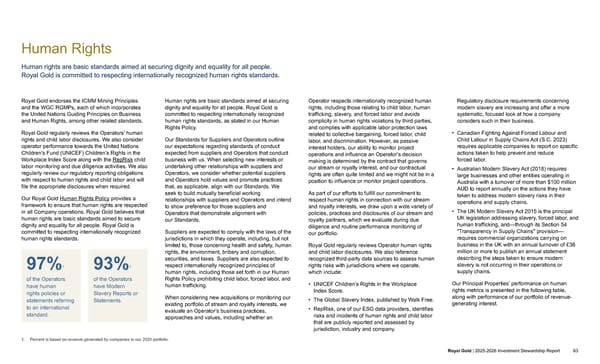
Human Rights Human rights are basic standards aimed at securing dignity and equality for all people. Royal Gold is committed to respecting internationally recognized human rights standards. Royal Gold endorses the ICMM Mining Principles and the WGC RGMPs, each of which incorporates the United Nations Guiding Principles on Business and Human Rights, among other related standards. Royal Gold regularly reviews the Operators’ human rights and child labor disclosures. We also consider operator performance towards the United Nations Children’s Fund (UNICEF) Children’s Rights in the Workplace Index Score along with the RepRisk child labor monitoring and due diligence activities. We also regularly review our regulatory reporting obligations with respect to human rights and child labor and will file the appropriate disclosures when required. Our Royal Gold Human Rights Policy provides a framework to ensure that human rights are respected in all Company operations. Royal Gold believes that human rights are basic standards aimed to secure dignity and equality for all people. Royal Gold is committed to respecting internationally recognized human rights standards. 97% 1 of the Operators have human rights policies or statements referring to an international standard. 93% 1 of the Operators have Modern Slavery Reports or Statements. Human rights are basic standards aimed at securing dignity and equality for all people. Royal Gold is committed to respecting internationally recognized human rights standards, as stated in our Human Rights Policy. Our Standards for Suppliers and Operators outline our expectations regarding standards of conduct expected from suppliers and Operators that conduct business with us. When selecting new interests or undertaking other relationships with suppliers and Operators, we consider whether potential suppliers and Operators hold values and promote practices that, as applicable, align with our Standards. We seek to build mutually beneficial working relationships with suppliers and Operators and intend to show preference for those suppliers and Operators that demonstrate alignment with our Standards. Suppliers are expected to comply with the laws of the jurisdictions in which they operate, including, but not limited to, those concerning health and safety, human rights, the environment, bribery and corruption, securities, and taxes. Suppliers are also expected to respect internationally recognized principles of human rights, including those set forth in our Human Rights Policy prohibiting child labor, forced labor, and human trafficking. When considering new acquisitions or monitoring our existing portfolio of stream and royalty interests, we evaluate an Operator’s business practices, approaches and values, including whether an Operator respects internationally recognized human rights, including those relating to child labor, human trafficking, slavery, and forced labor and avoids complicity in human rights violations by third parties, and complies with applicable labor protection laws related to collective bargaining, forced labor, child labor, and discrimination. However, as passive interest holders, our ability to monitor project operations and influence an Operator’s decision making is determined by the contract that governs our stream or royalty interest, and our contractual rights are often quite limited and we might not be in a position to influence or monitor project operations. As part of our efforts to fulfill our commitment to respect human rights in connection with our stream and royalty interests, we draw upon a wide variety of policies, practices and disclosures of our stream and royalty partners, which we evaluate during due diligence and routine performance monitoring of our portfolio. Royal Gold regularly reviews Operator human rights and child labor disclosures. We also reference recognized third-party data sources to assess human rights risks with jurisdictions where we operate, which include: • UNICEF Children’s Rights in the Workplace Index Score. • The Global Slavery Index, published by Walk Free. • RepRisk , one of our ESG data providers, identifies risks and incidents of human rights and child labor that are publicly reported and assessed by jurisdiction, industry and company. Regulatory disclosure requirements concerning modern slavery are increasing and offer a more systematic, focused look at how a company considers such in their business. • Canadian Fighting Against Forced Labour and Child Labour in Supply Chains Act (S.C. 2023) requires applicable companies to report on specific actions taken to help prevent and reduce forced labor. • Australian Modern Slavery Act (2018) requires large businesses and other entities operating in Australia with a turnover of more than $100 million AUD to report annually on the actions they have taken to address modern slavery risks in their operations and supply chains. • The UK Modern Slavery Act 2015 is the principal UK legislation addressing slavery, forced labor, and human trafficking, and—through its Section 54 "Transparency in Supply Chains" provision— requires commercial organizations carrying on business in the UK with an annual turnover of £36 million or more to publish an annual statement describing the steps taken to ensure modern slavery is not occurring in their operations or supply chains. Our Principal Properties’ performance on human rights metrics is presented in the following table, along with performance of our portfolio of revenue- generating interest. 1. Percent is based on revenue generated by companies in our 2025 portfolio. INTRODUCTION ABOUT ROYAL GOLD GOVERNANCE OUR PEOPLE OPERATORS AND COMMUNITIES INVESTMENT STEWARDSHIP APPENDICES Royal Gold | 2025-2026 Investment Stewardship Report 63
 2025–2026 Investment Stewardship Report Page 62 Page 64