
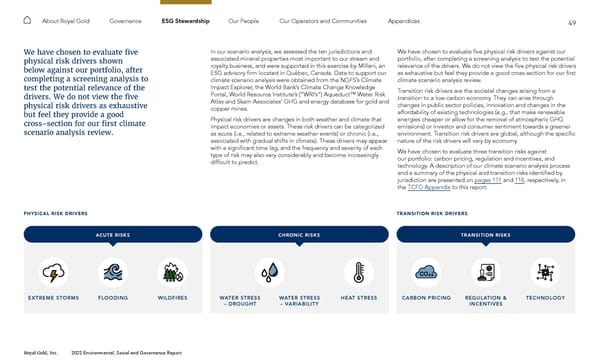
49 Royal Gold, Inc. 2022 Environmental, Social and Governance Report About Royal Gold Governance ESG Stewardship Our People Our Operators and Communities Appendices We have chosen to evaluate five physical risk drivers shown below against our portfolio, after completing a screening analysis to test the potential relevance of the drivers. We do not view the five physical risk drivers as exhaustive but feel they provide a good cross-section for our first climate scenario analysis review. PH YSIC AL R ISK DR IVER S EXTREME STORMS FLOODING WILDFIRES WATER STRESS – DROUGHT WATER STRESS – VARIABILITY HEAT STRESS TR ANSITION R ISK DR IVER S CARBON PRICING REGULATION & INCENTIVES TECHNOLOGY TR ANSITION R ISK S In our scenario analysis, we assessed the ten jurisdictions and associated mineral properties most important to our stream and royalty business, and were supported in this exercise by Millani, an ESG advisory firm located in Québec, Canada. Data to support our climate scenario analysis were obtained from the NGFS’s Climate Impact Explorer, the World Bank’s Climate Change Knowledge Portal, World Resource Institute’s (“WRI’s”) Aqueduct™ Water Risk Atlas and Skarn Associates’ GHG and energy database for gold and copper mines. Physical risk drivers are changes in both weather and climate that impact economies or assets. These risk drivers can be categorized as acute (i.e., related to extreme weather events) or chronic (i.e., associated with gradual shifts in climate). These drivers may appear with a significant time lag, and the frequency and severity of each type of risk may also vary considerably and become increasingly difficult to predict. We have chosen to evaluate five physical risk drivers against our portfolio, after completing a screening analysis to test the potential relevance of the drivers. We do not view the five physical risk drivers as exhaustive but feel they provide a good cross-section for our first climate scenario analysis review. Transition risk drivers are the societal changes arising from a transition to a low-carbon economy. They can arise through changes in public sector policies, innovation and changes in the affordability of existing technologies (e.g., that make renewable energies cheaper or allow for the removal of atmospheric GHG emissions) or investor and consumer sentiment towards a greener environment. Transition risk drivers are global, although the specific nature of the risk drivers will vary by economy. We have chosen to evaluate three transition risks against our portfolio: carbon pricing, regulation and incentives, and technology. A description of our climate scenario analysis process and a summary of the physical and transition risks identified by jurisdiction are presented on pages 111 and 118 , respectively, in the TCFD Appendix to this report. CHRONIC R ISK S ACUTE R ISK S
 2022 ESG Report Page 48 Page 50