
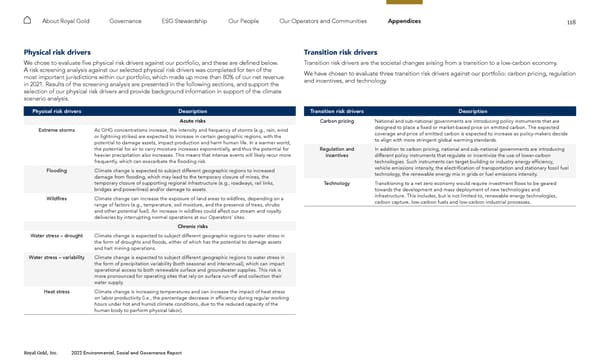
118 Royal Gold, Inc. 2022 Environmental, Social and Governance Report About Royal Gold Governance ESG Stewardship Our People Our Operators and Communities Appendices Physical risk drivers We chose to evaluate five physical risk drivers against our portfolio, and these are defined below. A risk screening analysis against our selected physical risk drivers was completed for ten of the most important jurisdictions within our portfolio, which made up more than 80% of our net revenue in 2021. Results of the screening analysis are presented in the following sections, and support the selection of our physical risk drivers and provide background information in support of the climate scenario analysis. Physical risk drivers Description Acute risks Extreme storms As GHG concentrations increase, the intensity and frequency of storms (e.g., rain, wind or lightning strikes) are expected to increase in certain geographic regions, with the potential to damage assets, impact production and harm human life. In a warmer world, the potential for air to carry moisture increases exponentially, and thus the potential for heavier precipitation also increases. This means that intense events will likely recur more frequently, which can exacerbate the flooding risk. Flooding Climate change is expected to subject different geographic regions to increased damage from flooding, which may lead to the temporary closure of mines, the temporary closure of supporting regional infrastructure (e.g., roadways, rail links, bridges and powerlines) and/or damage to assets. Wildfires Climate change can increase the exposure of land areas to wildfires, depending on a range of factors (e.g., temperature, soil moisture, and the presence of trees, shrubs and other potential fuel). An increase in wildfires could affect our stream and royalty deliveries by interrupting normal operations at our Operators’ sites. Chronic risks Water stress – drought Climate change is expected to subject different geographic regions to water stress in the form of droughts and floods, either of which has the potential to damage assets and halt mining operations. Water stress – variability Climate change is expected to subject different geographic regions to water stress in the form of precipitation variability (both seasonal and interannual), which can impact operational access to both renewable surface and groundwater supplies. This risk is more pronounced for operating sites that rely on surface run-off and collection their water supply. Heat stress Climate change is increasing temperatures and can increase the impact of heat stress on labor productivity (i.e., the percentage decrease in efficiency during regular working hours under hot and humid climate conditions, due to the reduced capacity of the human body to perform physical labor). Transition risk drivers Transition risk drivers are the societal changes arising from a transition to a low-carbon economy. We have chosen to evaluate three transition risk drivers against our portfolio: carbon pricing, regulation and incentives, and technology. Transition risk drivers Description Carbon pricing National and sub-national governments are introducing policy instruments that are designed to place a fixed or market-based price on emitted carbon. The expected coverage and price of emitted carbon is expected to increase as policy-makers decide to align with more stringent global warming standards. Regulation and incentives In addition to carbon pricing, national and sub-national governments are introducing different policy instruments that regulate or incentivize the use of lower-carbon technologies. Such instruments can target building or industry energy efficiency, vehicle emissions intensity, the electrification of transportation and stationary fossil fuel technology, the renewable energy mix in grids or fuel emissions intensity. Technology Transitioning to a net zero economy would require investment flows to be geared towards the development and mass deployment of new technologies and infrastructure. This includes, but is not limited to, renewable energy technologies, carbon capture, low-carbon fuels and low-carbon industrial processes.
 2022 ESG Report Page 117 Page 119