
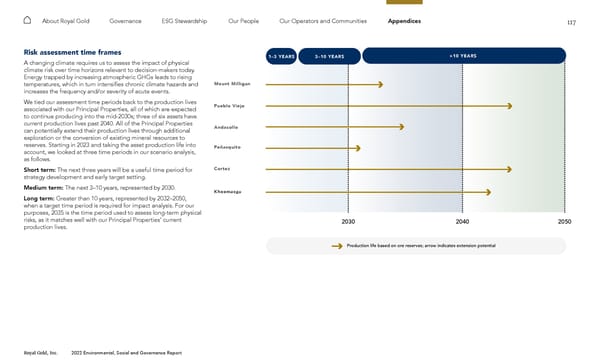
117 Royal Gold, Inc. 2022 Environmental, Social and Governance Report About Royal Gold Governance ESG Stewardship Our People Our Operators and Communities Appendices Risk assessment time frames A changing climate requires us to assess the impact of physical climate risk over time horizons relevant to decision-makers today. Energy trapped by increasing atmospheric GHGs leads to rising temperatures, which in turn intensifies chronic climate hazards and increases the frequency and/or severity of acute events. We tied our assessment time periods back to the production lives associated with our Principal Properties, all of which are expected to continue producing into the mid-2030s; three of six assets have current production lives past 2040. All of the Principal Properties can potentially extend their production lives through additional exploration or the conversion of existing mineral resources to reserves. Starting in 2023 and taking the asset production life into account, we looked at three time periods in our scenario analysis, as follows. Short term: The next three years will be a useful time period for strategy development and early target setting. Medium term: The next 3–10 years, represented by 2030. Long term: Greater than 10 years, represented by 2032–2050, when a target time period is required for impact analysis. For our purposes, 2035 is the time period used to assess long-term physical risks, as it matches well with our Principal Properties’ current production lives. Mount Milligan Pueblo Viejo Andacollo Peñasquito Cortez Khoemac au Production Life Extension Potential 2030 2040 2050 1–3 YEARS 3–10 YEARS >10 YEARS Production life based on ore reserves; arrow indicates extension potential
 2022 ESG Report Page 116 Page 118