
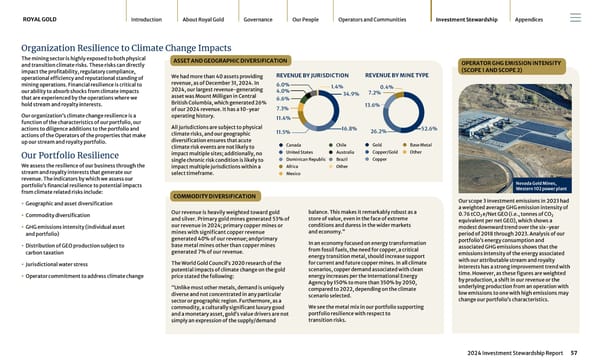
Organization Resilience to Climate Change Impacts The mining sector is highly exposed to both physical and transition climate risks. These risks can directly impact the profitability, regulatory compliance, operational efficiency and reputational standing of mining operations. Financial resilience is critical to our ability to absorb shocks from climate impacts that are experienced by the operations where we hold stream and royalty interests. Our organization’s climate change resilience is a function of the characteristics of our portfolio, our actions to diligence additions to the portfolio and actions of the Operators of the properties that make up our stream and royalty portfolio. Our Portfolio Resilience We assess the resilience of our business through the stream and royalty interests that generate our revenue. The indicators by which we assess our portfolio’s financial resilience to potential impacts from climate related risks include: • Geographic and asset diversification • Commodity diversification • GHG emissions intensity (individual asset and portfolio) • Distribution of GEO production subject to carbon taxation • Jurisdictional water stress • Operator commitment to address climate change ASSET AND GEOGRAPHIC DIVERSIFICATION We had more than 40 assets providing revenue, as of December 31, 2024. In 2024, our largest revenue-generating asset was Mount Milligan in Central British Columbia, which generated 26% of our 2024 revenue. It has a 10-year operating history. All jurisdictions are subject to physical climate risks, and our geographic diversification ensures that acute climate risk events are not likely to impact multiple sites; additionally, no single chronic risk condition is likely to impact multiple jurisdictions within a select timeframe. REVENUE BY JURISDICTION 7.3% 34.9% 16.8% 6.0% 4.0% 6.6% 11.5% 11.4% 1.4% Canada Chile United States Australia Dominican Republic Brazil Africa Other Mexico REVENUE BY MINE TYPE 0.4% 7.2% 13.6% 26.2% 52.6% Gold Base Metal Copper/Gold Other Copper COMMODITY DIVERSIFICATION Our revenue is heavily weighted toward gold and silver. Primary gold mines generated 53% of our revenue in 2024; primary copper mines or mines with significant copper revenue generated 40% of our revenue; and primary base metal mines other than copper mines generated 7% of our revenue. The World Gold Council’s 2020 research of the potential impacts of climate change on the gold price stated the following: “Unlike most other metals, demand is uniquely diverse and not concentrated in any particular sector or geographic region. Furthermore, as a commodity, a culturally significant luxury good and a monetary asset, gold’s value drivers are not simply an expression of the supply/demand balance. This makes it remarkably robust as a store of value, even in the face of extreme conditions and duress in the wider markets and economy.” In an economy focused on energy transformation from fossil fuels, the need for copper, a critical energy transition metal, should increase support for current and future copper mines. In all climate scenarios, copper demand associated with clean energy increases per the International Energy Agency by 150% to more than 350% by 2050, compared to 2022, depending on the climate scenario selected. We see the metal mix in our portfolio supporting portfolio resilience with respect to transition risks. OPERATOR GHG EMISSION INTENSITY (SCOPE 1 AND SCOPE 2) Our scope 3 investment emissions in 2023 had a weighted average GHG emission intensity of 0.76 tCO 2 e/Net GEO (i.e., tonnes of CO 2 equivalent per net GEO), which shows a modest downward trend over the six-year period of 2018 through 2023. Analysis of our portfolio’s energy consumption and associated GHG emissions shows that the emissions intensity of the energy associated with our attributable stream and royalty interests has a strong improvement trend with time. However, as these figures are weighted by production, a shift in our revenue or the underlying production from an operation with low emissions to one with high emissions may change our portfolio’s characteristics. ROYAL GOLD Introduction About Royal Gold Governance Our People Operators and Communities Investment Stewardship Appendices 2024 Investment Stewardship Report 57
 2024 Investment Stewardship Report Page 56 Page 58