
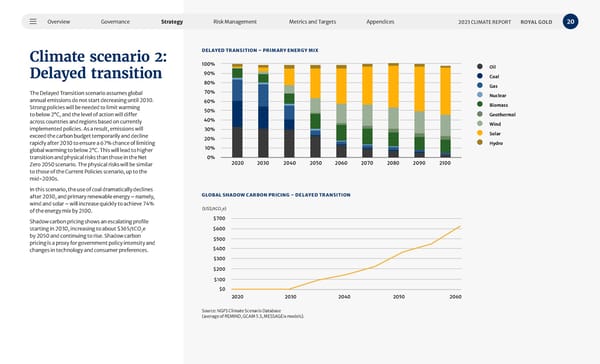
Overview Governance Strategy Risk Management Metrics and Targets Appendices 20 2023 CLIMATE REPORT ROYAL GOLD Climate scenario 2: Delayed transition The Delayed Transition scenario assumes global annual emissions do not start decreasing until 2030. Strong policies will be needed to limit warming to below 2°C, and the level of action will differ across countries and regions based on currently implemented policies. As a result, emissions will exceed the carbon budget temporarily and decline rapidly after 2030 to ensure a 67% chance of limiting global warming to below 2°C. This will lead to higher transition and physical risks than those in the Net Zero 2050 scenario. The physical risks will be similar to those of the Current Policies scenario, up to the mid-2030s. In this scenario, the use of coal dramatically declines after 2030, and primary renewable energy – namely, wind and solar – will increase quickly to achieve 74% of the energy mix by 2100. Shadow carbon pricing shows an escalating profile starting in 2030, increasing to about $365/tCO 2 e by 2050 and continuing to rise. Shadow carbon pricing is a proxy for government policy intensity and changes in technology and consumer preferences. DEL AYED TR ANSITION – PRIM ARY ENERGY MIX 0% 10% 20% 30% 40% 50% 60% 70% 80% 90% 100% 2030 2040 2050 2060 2070 2080 2090 2100 2020 GLOBAL SHADOW CARBON PRICING – DEL AYED TR ANSITION Source: NGFS Climate Scenario Database, (average of REMIND, GVAM 5.3, MESSAGE ix models) 2020 2030 2040 2050 2060 (US$/tCO 2 e) $0 $100 $200 $300 $400 $500 $600 $700 Source: NGFS Climate Scenario Database (average of REMIND, GCAM 5.3, MESSAGEix models). Oil Coal Gas Nuclear Biomass Geothermal Wind Solar Hydro
 2023 Climate Report Page 19 Page 21