
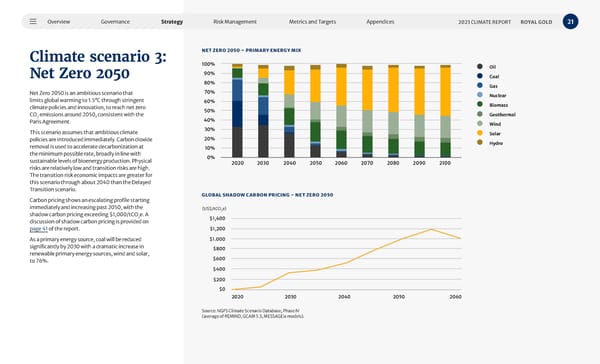
Overview Governance Strategy Risk Management Metrics and Targets Appendices 21 2023 CLIMATE REPORT ROYAL GOLD Climate scenario 3: Net Zero 2050 Net Zero 2050 is an ambitious scenario that limits global warming to 1.5°C through stringent climate policies and innovation, to reach net zero CO 2 emissions around 2050, consistent with the Paris Agreement. This scenario assumes that ambitious climate policies are introduced immediately. Carbon dioxide removal is used to accelerate decarbonization at the minimum possible rate, broadly in line with sustainable levels of bioenergy production. Physical risks are relatively low and transition risks are high. The transition risk economic impacts are greater for this scenario through about 2040 than the Delayed Transition scenario. Carbon pricing shows an escalating profile starting immediately and increasing past 2050, with the shadow carbon pricing exceeding $1,000/tCO 2 e. A discussion of shadow carbon pricing is provided on page 41 of the report. As a primary energy source, coal will be reduced significantly by 2030 with a dramatic increase in renewable primary energy sources, wind and solar, to 76%. NET ZERO 2050 – PRIM ARY ENERGY MIX 0% 10% 20% 30% 40% 50% 60% 70% 80% 90% 100% 2030 2040 2050 2060 2070 2080 2090 2100 2020 GLOBAL SHADOW CARBON PRICING – NET ZERO 2050 Source: NGFS Climate Scenario Database, (average of REMIND, GVAM 5.3, MESSAGE ix models) 2020 2030 2040 2050 2060 (US$/tCO 2 e) $0 $200 $400 $600 $800 $1.000 $1,200 $1,400 Oil Coal Gas Nuclear Biomass Geothermal Wind Solar Hydro Source: NGFS Climate Scenario Database, Phase IV (average of REMIND, GCAM 5.3, MESSAGEix models).
 2023 Climate Report Page 20 Page 22