
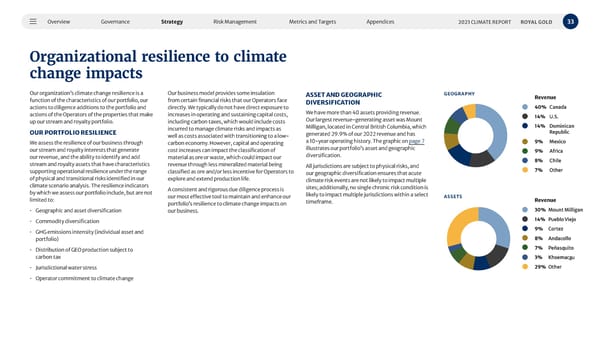
Overview Governance Strategy Risk Management Metrics and Targets Appendices 33 2023 CLIMATE REPORT ROYAL GOLD Organizational resilience to climate change impacts Our organization’s climate change resilience is a function of the characteristics of our portfolio, our actions to diligence additions to the portfolio and actions of the Operators of the properties that make up our stream and royalty portfolio. OUR PORTFOLIO RESILIENCE We assess the resilience of our business through our stream and royalty interests that generate our revenue, and the ability to identify and add stream and royalty assets that have characteristics supporting operational resilience under the range of physical and transitional risks identified in our climate scenario analysis. The resilience indicators by which we assess our portfolio include, but are not limited to: • Geographic and asset diversification • Commodity diversification • GHG emissions intensity (individual asset and portfolio) • Distribution of GEO production subject to carbon tax • Jurisdictional water stress • Operator commitment to climate change Our business model provides some insulation from certain financial risks that our Operators face directly. We typically do not have direct exposure to increases in operating and sustaining capital costs, including carbon taxes, which would include costs incurred to manage climate risks and impacts as well as costs associated with transitioning to a low- carbon economy. However, capital and operating cost increases can impact the classification of material as ore or waste, which could impact our revenue through less mineralized material being classified as ore and/or less incentive for Operators to explore and extend production life. A consistent and rigorous due diligence process is our most effective tool to maintain and enhance our portfolio’s resilience to climate change impacts on our business. ASSET AND GEOGRAPHIC DIVERSIFICATION We have more than 40 assets providing revenue. Our largest revenue-generating asset was Mount Milligan, located in Central British Columbia, which generated 29.9% of our 2022 revenue and has a 10-year operating history. The graphic on page 7 illustrates our portfolio’s asset and geographic diversification. All jurisdictions are subject to physical risks, and our geographic diversification ensures that acute climate risk events are not likely to impact multiple sites; additionally, no single chronic risk condition is likely to impact multiple jurisdictions within a select timeframe. GEOGRAPHY ASSETS Revenue 40% Canada 14% U.S. 14% Dominican Republic 9% Mexico 9% Africa 8% Chile 7% Other Revenue 30% Mount Milligan 14% Pueblo Viejo 9% Cortez 8% Andacollo 7% Peñasquito 3% Khoemac a u 29% Other
 2023 Climate Report Page 32 Page 34