
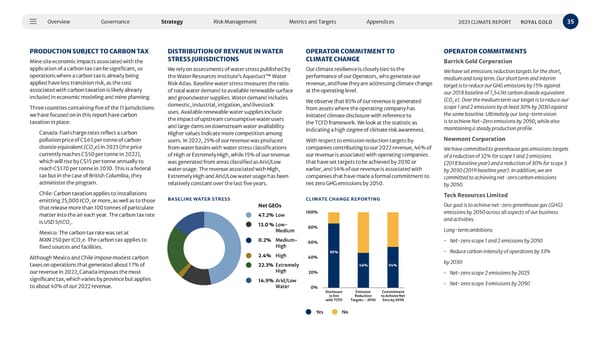
Overview Governance Strategy Risk Management Metrics and Targets Appendices 35 2023 CLIMATE REPORT ROYAL GOLD PRODUCTION SUBJECT TO CARBON TAX Mine site economic impacts associated with the application of a carbon tax can be significant, so operations where a carbon tax is already being applied have less transition risk, as the cost associated with carbon taxation is likely already included in economic modeling and mine planning. Three countries containing five of the 11 jurisdictions we have focused on in this report have carbon taxation in place: Canada: Fuel charge rates reflect a carbon pollution price of C$65 per tonne of carbon dioxide equivalent (CO 2 e) in 2023 (the price currently reaches C$50 per tonne in 2022), which will rise by C$15 per tonne annually to reach C$170 per tonne in 2030. This is a federal tax but in the case of British Columbia, they administer the program. Chile: Carbon taxation applies to installations emitting 25,000 tCO 2 or more, as well as to those that release more than 100 tonnes of particulate matter into the air each year. The carbon tax rate is USD 5/tCO 2 . Mexico: The carbon tax rate was set at MXN 250 per tCO 2 e. The carbon tax applies to fixed sources and facilities. Although Mexico and Chile impose modest carbon taxes on operations that generated about 17% of our revenue in 2022, Canada imposes the most significant tax, which varies by province but applies to about 40% of our 2022 revenue. DISTRIBUTION OF REVENUE IN WATER STRESS JURISDICTIONS We rely on assessments of water stress published by the Water Resources Institute’s Aqueduct™ Water Risk Atlas. Baseline water stress measures the ratio of total water demand to available renewable surface and groundwater supplies. Water demand includes domestic, industrial, irrigation, and livestock uses. Available renewable water supplies include the impact of upstream consumptive water users and large dams on downstream water availability. Higher values indicate more competition among users. In 2022, 25% of our revenue was produced from water basins with water stress classifications of High or Extremely High, while 15% of our revenue was generated from areas classified as Arid/Low water usage. The revenue associated with High, Extremely High and Arid/Low water usage has been relatively constant over the last five years. BASELINE WATER STRESS OPERATOR COMMITMENT TO CLIMATE CHANGE Our climate resilience is closely tied to the performance of our Operators, who generate our revenue, and how they are addressing climate change at the operating level. We observe that 85% of our revenue is generated from assets where the operating company has initiated climate disclosure with reference to the TCFD framework. We look at the statistic as indicating a high degree of climate risk awareness. With respect to emission reduction targets by companies contributing to our 2022 revenue, 46% of our revenue is associated with operating companies that have set targets to be achieved by 2030 or earlier, and 54% of our revenue is associated with companies that have made a formal commitment to net zero GHG emissions by 2050. CLIMATE CHANGE REPORTING 0% 20% 40% 60% 80% 100% Commitment to Achieve Net Zero by 2050 Emission Reduction Targets – 2030 Disclosure in line with TCFD Yes No % of Alignment 85% 46% 54% OPERATOR COMMITMENTS Barrick Gold Corporation We have set emissions reduction targets for the short, medium and long term. Our short term and interim target is to reduce our GHG emissions by 15% against our 2018 baseline of 7,541kt carbon dioxide equivalent (CO 2 e). Over the medium term our target is to reduce our scope 1 and 2 emissions by at least 30% by 2030 against the same baseline. Ultimately our long-term vision is to achieve Net-Zero emissions by 2050, while also maintaining a steady production profile. Newmont Corporation We have committed to greenhouse gas emissions targets of a reduction of 32% for scope 1 and 2 emissions (2018 baseline year) and a reduction of 30% for scope 3 by 2030 (2019 baseline year). In addition, we are committed to achieving net-zero carbon emissions by 2050. Teck Resources Limited Our goal is to achieve net-zero greenhouse gas (GHG) emissions by 2050 across all aspects of our business and activities. Long-term ambitions: • Net-zero scope 1 and 2 emissions by 2050 • Reduce carbon intensity of operations by 33% by 2030 • Net-zero scope 2 emissions by 2025 • Net-zero scope 3 emissions by 2050 Net GEOs 47.2% Low 13.0 % Low- Medium 0.2% Medium- High 2.4% High 22.3% Extremely High 14.9% Arid/Low Water Yes No
 2023 Climate Report Page 34 Page 36