
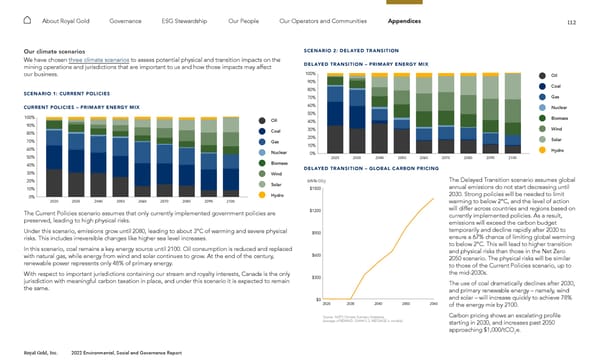
112 Royal Gold, Inc. 2022 Environmental, Social and Governance Report About Royal Gold Governance ESG Stewardship Our People Our Operators and Communities Appendices Our climate scenarios We have chosen three climate scenarios to assess potential physical and transition impacts on the mining operations and jurisdictions that are important to us and how those impacts may affect our business. SCENAR IO 1: CUR RENT POLICIES CUR RENT POLICIES – PR IMARY ENERGY MIX The Current Policies scenario assumes that only currently implemented government policies are preserved, leading to high physical risks. Under this scenario, emissions grow until 2080, leading to about 3°C of warming and severe physical risks. This includes irreversible changes like higher sea level increases. In this scenario, coal remains a key energy source until 2100. Oil consumption is reduced and replaced with natural gas, while energy from wind and solar continues to grow. At the end of the century, renewable power represents only 48% of primary energy. With respect to important jurisdictions containing our stream and royalty interests, Canada is the only jurisdiction with meaningful carbon taxation in place, and under this scenario it is expected to remain the same. SCENAR IO 2: DEL AY ED TR ANSITION DEL AY ED TR ANSITION – PR IMARY ENERGY MIX DEL AY ED TR ANSITION – GLOBAL C AR B ON PR ICING $0 $300 $600 $900 $1200 $1500 2020 2030 (US/$t CO 2 ) 2040 2050 2060 Source: NGFS Climate Scenario Database, (average of REMIND, GVAM 5.3, MESSAGE ix models) The Delayed Transition scenario assumes global annual emissions do not start decreasing until 2030. Strong policies will be needed to limit warming to below 2°C, and the level of action will differ across countries and regions based on currently implemented policies. As a result, emissions will exceed the carbon budget temporarily and decline rapidly after 2030 to ensure a 67% chance of limiting global warming to below 2°C. This will lead to higher transition and physical risks than those in the Net Zero 2050 scenario. The physical risks will be similar to those of the Current Policies scenario, up to the mid-2030s. The use of coal dramatically declines after 2030, and primary renewable energy – namely, wind and solar – will increase quickly to achieve 78% of the energy mix by 2100. Carbon pricing shows an escalating profile starting in 2030, and increases past 2050 approaching $1,000/tCO 2 e. 0% 10% 20% 30% 40% 50% 60% 70% 80% 90% 100% 2030 2040 2050 2060 2070 2080 2090 2100 2020 Oil Coal Gas Nuclear Biomass Wind Solar Hydro 0% 10% 20% 30% 40% 50% 60% 70% 80% 90% 100% 2030 2040 2050 2060 2070 2080 2090 2100 2020 Oil Coal Gas Nuclear Biomass Wind Solar Hydro
 2022 ESG Report Page 111 Page 113