
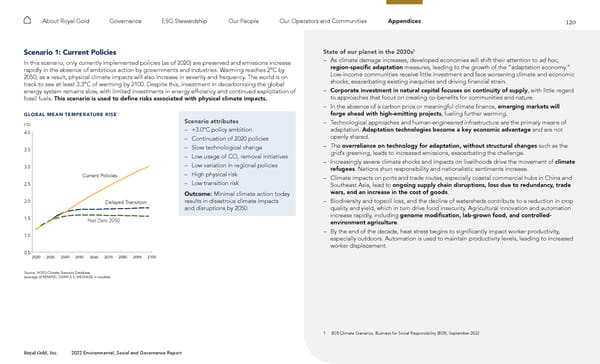
120 Royal Gold, Inc. 2022 Environmental, Social and Governance Report About Royal Gold Governance ESG Stewardship Our People Our Operators and Communities Appendices Scenario 1: Current Policies In this scenario, only currently implemented policies (as of 2020) are preserved and emissions increase rapidly in the absence of ambitious action by governments and industries. Warming reaches 2°C by 2050; as a result, physical climate impacts will also increase in severity and frequency. The world is on track to see at least 3.3°C of warming by 2100. Despite this, investment in decarbonizing the global energy system remains slow, with limited investments in energy efficiency and continued exploitation of fossil fuels. This scenario is used to define risks associated with physical climate impacts. GLOBAL ME AN TEMPER ATURE R ISE 0.5 1.0 1.5 2.0 2.5 3.0 3.5 4.0 2020 2040 (°C) 2060 2080 2100 Net Zero 2050 Delayed Transition Current Policies Source: NGFS Climate Scenario Database, (average of REMIND, GVAM 5.3, MESSAGE ix models) Current Policies Delayed Transition Net Zero 2050 2030 2050 2070 2090 10 20 30 40 50 2020 2030 (Gt CO 2 ) 2040 2050 2060 Net Zero 2050 Delayed Transition Current Policies Source: NGFS Climate Scenario Database, (average of REMIND, GVAM 5.3, MESSAGE ix models) Current Policies Delayed Transition Net Zero 2050 Scenario attributes – +3.0°C policy ambition – Continuation of 2020 policies – Slow technological change – Low usage of CO 2 removal initiatives – Low variation in regional policies – High physical risk – Low transition risk Outcome: Minimal climate action today results in disastrous climate impacts and disruptions by 2050. State of our planet in the 2030s 1 – As climate damage increases, developed economies will shift their attention to ad hoc , region-specific adaptation measures, leading to the growth of the “adaptation economy.” Low-income communities receive little investment and face worsening climate and economic shocks, exacerbating existing inequities and driving financial strain. – Corporate investment in natural capital focuses on continuity of supply , with little regard to approaches that focus on creating co-benefits for communities and nature. – In the absence of a carbon price or meaningful climate finance, emerging markets will forge ahead with high-emitting projects , fueling further warming. – Technological approaches and human-engineered infrastructure are the primary means of adaptation. Adaptation technologies become a key economic advantage and are not openly shared. – The overreliance on technology for adaptation, without structural changes such as the grid’s greening, leads to increased emissions, exacerbating the challenge. – Increasingly severe climate shocks and impacts on livelihoods drive the movement of climate refugees . Nations shun responsibility and nationalistic sentiments increase. – Climate impacts on ports and trade routes, especially coastal commercial hubs in China and Southeast Asia, lead to ongoing supply chain disruptions, loss due to redundancy, trade wars, and an increase in the cost of goods . – Biodiversity and topsoil loss, and the decline of watersheds contribute to a reduction in crop quality and yield, which in turn drive food insecurity. Agricultural innovation and automation increase rapidly, including genome modification, lab-grown food, and controlled- environment agriculture . – By the end of the decade, heat stress begins to significantly impact worker productivity, especially outdoors. Automation is used to maintain productivity levels, leading to increased worker displacement. 1 BSR Climate Scenarios, Business for Social Responsibility (BSR), September 2022
 2022 ESG Report Page 119 Page 121