
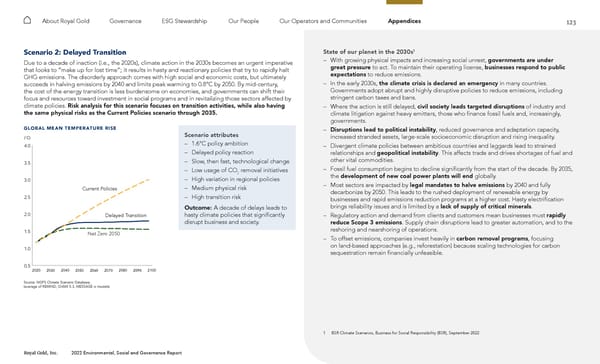
123 Royal Gold, Inc. 2022 Environmental, Social and Governance Report About Royal Gold Governance ESG Stewardship Our People Our Operators and Communities Appendices Scenario 2: Delayed Transition Due to a decade of inaction (i.e., the 2020s), climate action in the 2030s becomes an urgent imperative that looks to “make up for lost time”; it results in hasty and reactionary policies that try to rapidly halt GHG emissions. The disorderly approach comes with high social and economic costs, but ultimately succeeds in halving emissions by 2040 and limits peak warming to 0.8°C by 2050. By mid-century, the cost of the energy transition is less burdensome on economies, and governments can shift their focus and resources toward investment in social programs and in revitalizing those sectors affected by climate policies. Risk analysis for this scenario focuses on transition activities, while also having the same physical risks as the Current Policies scenario through 2035. GLOBAL ME AN TEMPER ATURE R ISE 0.5 1.0 1.5 2.0 2.5 3.0 3.5 4.0 2020 2040 (°C) 2060 2080 2100 Net Zero 2050 Delayed Transition Current Policies Source: NGFS Climate Scenario Database, (average of REMIND, GVAM 5.3, MESSAGE ix models) Current Policies Delayed Transition Net Zero 2050 2030 2050 2070 2090 10 20 30 40 50 2020 2030 (Gt CO 2 ) 2040 2050 2060 Net Zero 2050 Delayed Transition Current Policies Source: NGFS Climate Scenario Database, (average of REMIND, GVAM 5.3, MESSAGE ix models) Current Policies Delayed Transition Net Zero 2050 Scenario attributes – 1.6°C policy ambition – Delayed policy reaction – Slow, then fast, technological change – Low usage of CO 2 removal initiatives – High variation in regional policies – Medium physical risk – High transition risk Outcome: A decade of delays leads to hasty climate policies that significantly disrupt business and society. State of our planet in the 2030s 1 – With growing physical impacts and increasing social unrest, governments are under great pressure to act. To maintain their operating license, businesses respond to public expectations to reduce emissions. – In the early 2030s, the climate crisis is declared an emergency in many countries. Governments adopt abrupt and highly disruptive policies to reduce emissions, including stringent carbon taxes and bans. – Where the action is still delayed, civil society leads targeted disruptions of industry and climate litigation against heavy emitters, those who finance fossil fuels and, increasingly, governments. – Disruptions lead to political instability , reduced governance and adaptation capacity, increased stranded assets, large-scale socioeconomic disruption and rising inequality. – Divergent climate policies between ambitious countries and laggards lead to strained relationships and geopolitical instability . This affects trade and drives shortages of fuel and other vital commodities. – Fossil fuel consumption begins to decline significantly from the start of the decade. By 2035, the development of new coal power plants will end globally. – Most sectors are impacted by legal mandates to halve emissions by 2040 and fully decarbonize by 2050. This leads to the rushed deployment of renewable energy by businesses and rapid emissions reduction programs at a higher cost. Hasty electrification brings reliability issues and is limited by a lack of supply of critical minerals . – Regulatory action and demand from clients and customers mean businesses must rapidly reduce Scope 3 emissions . Supply chain disruptions lead to greater automation, and to the reshoring and nearshoring of operations. – To offset emissions, companies invest heavily in carbon removal programs , focusing on land-based approaches (e.g., reforestation) because scaling technologies for carbon sequestration remain financially unfeasible. 1 BSR Climate Scenarios, Business for Social Responsibility (BSR), September 2022
 2022 ESG Report Page 122 Page 124