
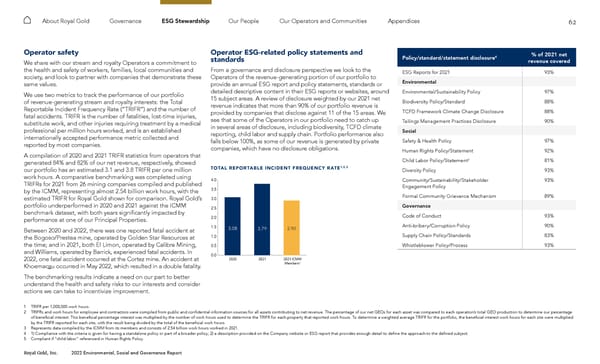
62 Royal Gold, Inc. 2022 Environmental, Social and Governance Report About Royal Gold Governance ESG Stewardship Our People Our Operators and Communities Appendices Operator safety We share with our stream and royalty Operators a commitment to the health and safety of workers, families, local communities and society, and look to partner with companies that demonstrate these same values. We use two metrics to track the performance of our portfolio of revenue-generating stream and royalty interests: the Total Reportable Incident Frequency Rate (“TRIFR”) and the number of fatal accidents. TRIFR is the number of fatalities, lost-time injuries, substitute work, and other injuries requiring treatment by a medical professional per million hours worked, and is an established internationally accepted performance metric collected and reported by most companies. A compilation of 2020 and 2021 TRIFR statistics from operators that generated 84% and 82% of our net revenue, respectively, showed our portfolio has an estimated 3.1 and 3.8 TRIFR per one million work hours. A comparative benchmarking was completed using TRIFRs for 2021 from 26 mining companies compiled and published by the ICMM, representing almost 2.54 billion work hours, with the estimated TRIFR for Royal Gold shown for comparison. Royal Gold’s portfolio underperformed in 2020 and 2021 against the ICMM benchmark dataset, with both years significantly impacted by performance at one of our Principal Properties. Between 2020 and 2022, there was one reported fatal accident at the Bogoso/Prestea mine, operated by Golden Star Resources at the time; and in 2021, both El Limon, operated by Calibre Mining, and Williams, operated by Barrick, experienced fatal accidents. In 2022, one fatal accident occurred at the Cortez mine. An accident at Khoemac a u occurred in May 2022, which resulted in a double fatality. The benchmarking results indicate a need on our part to better understand the health and safety risks to our interests and consider actions we can take to incentivize improvement. Operator ESG-related policy statements and standards From a governance and disclosure perspective we look to the Operators of the revenue-generating portion of our portfolio to provide an annual ESG report and policy statements, standards or detailed descriptive content in their ESG reports or websites, around 15 subject areas. A review of disclosure weighted by our 2021 net revenue indicates that more than 90% of our portfolio revenue is provided by companies that disclose against 11 of the 15 areas. We see that some of the Operators in our portfolio need to catch up in several areas of disclosure, including biodiversity, TCFD climate reporting, child labor and supply chain. Portfolio performance also falls below 100%, as some of our revenue is generated by private companies, which have no disclosure obligations. TOTAL REPOR TAB LE INCIDENT FREQUENC Y R ATE 1, 2 , 3 0.0 0.5 1.0 1.5 2.0 2.5 3.0 3.5 4.0 2021 ICMM Members 4 2021 2020 3.08 3.79 2.90 (1) TRIFR per 100,000 work hours (2) Represents data compiled by the ICMM from its members and consists of 2.54 billions work hours worked in 2021. (3) (4) 1 fatal accident in 2020 and 2 fatal accidents in 2021. Policy/standard/statement disclosure 4 % of 2021 net revenue covered ESG Reports for 2021 93% Environmental Environmental/Sustainability Policy 97% Biodiversity Policy/Standard 88% TCFD Framework Climate Change Disclosure 88% Tailings Management Practices Disclosure 90% Social Safety & Health Policy 97% Human Rights Policy/Statement 92% Child Labor Policy/Statement 5 81% Diversity Policy 93% Community/Sustainability/Stakeholder Engagement Policy 93% Formal Community Grievance Mechanism 89% Governance Code of Conduct 93% Anti-bribery/Corruption Policy 90% Supply Chain Policy/Standards 83% Whistleblower Policy/Process 93% 1 TRIFR per 1,000,000 work hours. 2 TRIFRs and work hours for employee and contractors were compiled from public and confidential information sources for all assets contributing to net revenue. The percentage of our net GEOs for each asset was compared to each operation’s total GEO production to determine our percentage of beneficial interest. This beneficial percentage interest was multiplied by the number of work hours used to determine the TRIFR for each property that reported work hours. To determine a weighted average TRIFR for the portfolio, the beneficial interest work hours for each site were multiplied by the TRIFR reported for each site, with the result being divided by the total of the beneficial work hours. 3 Represents data compiled by the ICMM from its members and consists of 2.54 billion work hours worked in 2021. 4 1) Compliance with the criteria is given for having a standalone policy or part of a broader policy; 2) a description provided on the Company website or ESG report that provides enough detail to define the approach to the defined subject 5 Compliant if “child labor” referenced in Human Rights Policy.
 2022 ESG Report Page 61 Page 63