
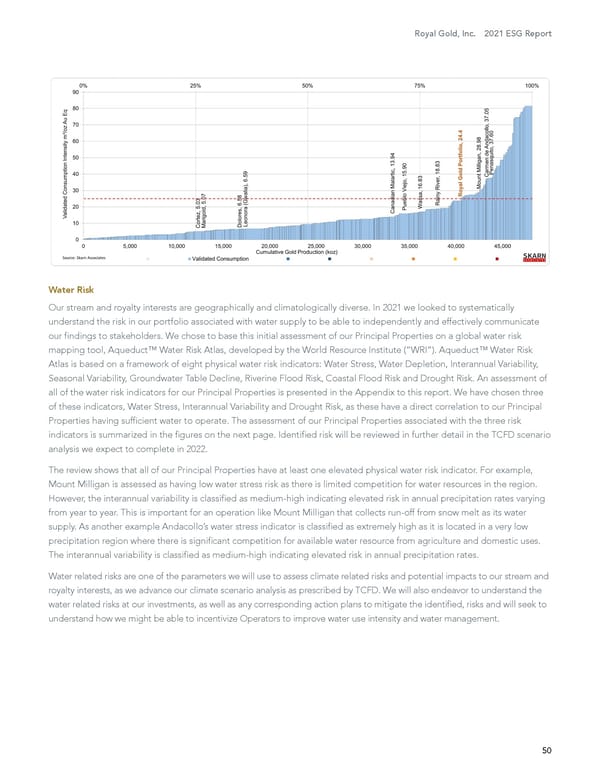
Royal Gold, Inc. 2021 ESG Report 50 Water Risk Our stream and royalty interests are geographically and climatologically diverse. In 2021 we looked to systematically understand the risk in our portfolio associated with water supply to be able to independently and effectively communicate our findings to stakeholders. We chose to base this initial assessment of our Principal Properties on a global water risk mapping tool, Aqueduct™ Water Risk Atlas, developed by the World Resource Institute (“WRI”). Aqueduct™ Water Risk Atlas is based on a framework of eight physical water risk indicators: Water Stress, Water Depletion, Interannual Variability, Seasonal Variability, Groundwater Table Decline, Riverine Flood Risk, Coastal Flood Risk and Drought Risk. An assessment of all of the water risk indicators for our Principal Properties is presented in the Appendix to this report. We have chosen three of these indicators, Water Stress, Interannual Variability and Drought Risk, as these have a direct correlation to our Principal Properties having sufficient water to operate. The assessment of our Principal Properties associated with the three risk indicators is summarized in the figures on the next page. Identified risk will be reviewed in further detail in the TCFD scenario analysis we expect to complete in 2022. The review shows that all of our Principal Properties have at least one elevated physical water risk indicator. For example, Mount Milligan is assessed as having low water stress risk as there is limited competition for water resources in the region. However, the interannual variability is classified as medium-high indicating elevated risk in annual precipitation rates varying from year to year. This is important for an operation like Mount Milligan that collects run-off from snow melt as its water supply. As another example Andacollo’s water stress indicator is classified as extremely high as it is located in a very low precipitation region where there is significant competition for available water resource from agriculture and domestic uses. The interannual variability is classified as medium-high indicating elevated risk in annual precipitation rates. Water related risks are one of the parameters we will use to assess climate related risks and potential impacts to our stream and royalty interests, as we advance our climate scenario analysis as prescribed by TCFD. We will also endeavor to understand the water related risks at our investments, as well as any corresponding action plans to mitigate the identified, risks and will seek to understand how we might be able to incentivize Operators to improve water use intensity and water management.
 2021 Environment, Social and Governance Report Page 50 Page 52