
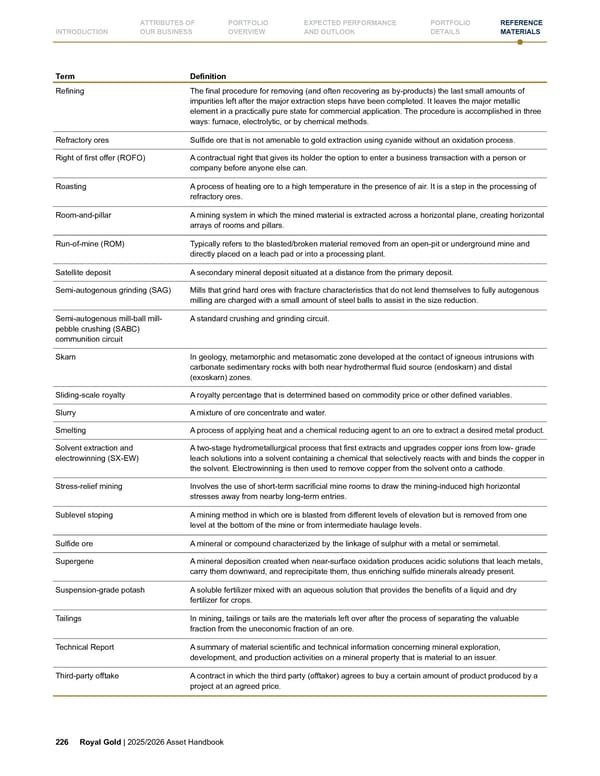
Term Definition Refining The final procedure for removing (and often recovering as by-products) the last small amounts of impurities left after the major extraction steps have been completed. It leaves the major metallic element in a practically pure state for commercial application. The procedure is accomplished in three ways: furnace, electrolytic, or by chemical methods. Refractory ores Sulfide ore that is not amenable to gold extraction using cyanide without an oxidation process. Right of first offer (ROFO) A contractual right that gives its holder the option to enter a business transaction with a person or company before anyone else can. Roasting A process of heating ore to a high temperature in the presence of air. It is a step in the processing of refractory ores. Room-and-pillar A mining system in which the mined material is extracted across a horizontal plane, creating horizontal arrays of rooms and pillars. Run-of-mine (ROM) Typically refers to the blasted/broken material removed from an open-pit or underground mine and directly placed on a leach pad or into a processing plant. Satellite deposit A secondary mineral deposit situated at a distance from the primary deposit. Semi-autogenous grinding (SAG) Mills that grind hard ores with fracture characteristics that do not lend themselves to fully autogenous milling are charged with a small amount of steel balls to assist in the size reduction. Semi-autogenous mill-ball mill- pebble crushing (SABC) communition circuit A standard crushing and grinding circuit. Skarn In geology, metamorphic and metasomatic zone developed at the contact of igneous intrusions with carbonate sedimentary rocks with both near hydrothermal fluid source (endoskarn) and distal (exoskarn) zones. Sliding-scale royalty A royalty percentage that is determined based on commodity price or other defined variables. Slurry A mixture of ore concentrate and water. Smelting A process of applying heat and a chemical reducing agent to an ore to extract a desired metal product. Solvent extraction and electrowinning (SX-EW) A two-stage hydrometallurgical process that first extracts and upgrades copper ions from low- grade leach solutions into a solvent containing a chemical that selectively reacts with and binds the copper in the solvent. Electrowinning is then used to remove copper from the solvent onto a cathode. Stress-relief mining Involves the use of short-term sacrificial mine rooms to draw the mining-induced high horizontal stresses away from nearby long-term entries. Sublevel stoping A mining method in which ore is blasted from different levels of elevation but is removed from one level at the bottom of the mine or from intermediate haulage levels. Sulfide ore A mineral or compound characterized by the linkage of sulphur with a metal or semimetal. Supergene A mineral deposition created when near-surface oxidation produces acidic solutions that leach metals, carry them downward, and reprecipitate them, thus enriching sulfide minerals already present. Suspension-grade potash A soluble fertilizer mixed with an aqueous solution that provides the benefits of a liquid and dry fertilizer for crops. Tailings In mining, tailings or tails are the materials left over after the process of separating the valuable fraction from the uneconomic fraction of an ore. Technical Report A summary of material scientific and technical information concerning mineral exploration, development, and production activities on a mineral property that is material to an issuer. Third-party offtake A contract in which the third party (offtaker) agrees to buy a certain amount of product produced by a project at an agreed price. 226 Royal Gold | 2025/2026 Asset Handbook INTRODUCTION ATTRIBUTES OF OUR BUSINESS PORTFOLIO OVERVIEW EXPECTED PERFORMANCE AND OUTLOOK PORTFOLIO DETAILS REFERENCE MATERIALS
 Royal Gold, Inc. 2025/2026 Asset Handbook Page 225 Page 227