
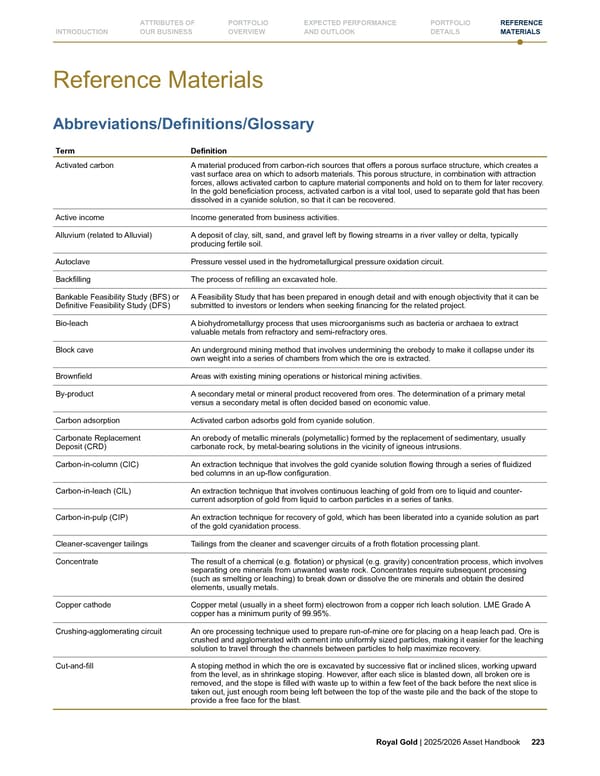
Reference Materials Abbreviations/Definitions/Glossary Term Definition Activated carbon A material produced from carbon-rich sources that offers a porous surface structure, which creates a vast surface area on which to adsorb materials. This porous structure, in combination with attraction forces, allows activated carbon to capture material components and hold on to them for later recovery. In the gold beneficiation process, activated carbon is a vital tool, used to separate gold that has been dissolved in a cyanide solution, so that it can be recovered. Active income Income generated from business activities. Alluvium (related to Alluvial) A deposit of clay, silt, sand, and gravel left by flowing streams in a river valley or delta, typically producing fertile soil. Autoclave Pressure vessel used in the hydrometallurgical pressure oxidation circuit. Backfilling The process of refilling an excavated hole. Bankable Feasibility Study (BFS) or Definitive Feasibility Study (DFS) A Feasibility Study that has been prepared in enough detail and with enough objectivity that it can be submitted to investors or lenders when seeking financing for the related project. Bio-leach A biohydrometallurgy process that uses microorganisms such as bacteria or archaea to extract valuable metals from refractory and semi-refractory ores. Block cave An underground mining method that involves undermining the orebody to make it collapse under its own weight into a series of chambers from which the ore is extracted. Brownfield Areas with existing mining operations or historical mining activities. By-product A secondary metal or mineral product recovered from ores. The determination of a primary metal versus a secondary metal is often decided based on economic value. Carbon adsorption Activated carbon adsorbs gold from cyanide solution. Carbonate Replacement Deposit (CRD) An orebody of metallic minerals (polymetallic) formed by the replacement of sedimentary, usually carbonate rock, by metal-bearing solutions in the vicinity of igneous intrusions. Carbon-in-column (CIC) An extraction technique that involves the gold cyanide solution flowing through a series of fluidized bed columns in an up-flow configuration. Carbon-in-leach (CIL) An extraction technique that involves continuous leaching of gold from ore to liquid and counter- current adsorption of gold from liquid to carbon particles in a series of tanks. Carbon-in-pulp (CIP) An extraction technique for recovery of gold, which has been liberated into a cyanide solution as part of the gold cyanidation process. Cleaner-scavenger tailings Tailings from the cleaner and scavenger circuits of a froth flotation processing plant. Concentrate The result of a chemical (e.g. flotation) or physical (e.g. gravity) concentration process, which involves separating ore minerals from unwanted waste rock. Concentrates require subsequent processing (such as smelting or leaching) to break down or dissolve the ore minerals and obtain the desired elements, usually metals. Copper cathode Copper metal (usually in a sheet form) electrowon from a copper rich leach solution. LME Grade A copper has a minimum purity of 99.95%. Crushing-agglomerating circuit An ore processing technique used to prepare run-of-mine ore for placing on a heap leach pad. Ore is crushed and agglomerated with cement into uniformly sized particles, making it easier for the leaching solution to travel through the channels between particles to help maximize recovery. Cut-and-fill A stoping method in which the ore is excavated by successive flat or inclined slices, working upward from the level, as in shrinkage stoping. However, after each slice is blasted down, all broken ore is removed, and the stope is filled with waste up to within a few feet of the back before the next slice is taken out, just enough room being left between the top of the waste pile and the back of the stope to provide a free face for the blast. Royal Gold | 2025/2026 Asset Handbook 223 INTRODUCTION ATTRIBUTES OF OUR BUSINESS PORTFOLIO OVERVIEW EXPECTED PERFORMANCE AND OUTLOOK PORTFOLIO DETAILS REFERENCE MATERIALS
 Royal Gold, Inc. 2025/2026 Asset Handbook Page 222 Page 224