
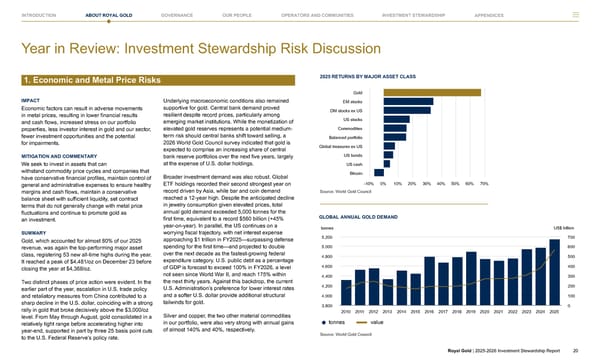
Year in Review: Investment Stewardship Risk Discussion Royal Gold | 2025-2026 Investment Stewardship Report 20 1. Economic and Metal Price Risks IMPACT Economic factors can result in adverse movements in metal prices, resulting in lower financial results and cash flows, increased stress on our portfolio properties, less investor interest in gold and our sector, fewer investment opportunities and the potential for impairments. MITIGATION AND COMMENTARY We seek to invest in assets that can withstand commodity price cycles and companies that have conservative financial profiles, maintain control of general and administrative expenses to ensure healthy margins and cash flows, maintain a conservative balance sheet with sufficient liquidity, set contract terms that do not generally change with metal price fluctuations and continue to promote gold as an investment. SUMMARY Gold, which accounted for almost 80% of our 2025 revenue, was again the top-performing major asset class, registering 53 new all-time highs during the year. It reached a peak of $4,481/oz on December 23 before closing the year at $4,368/oz. Two distinct phases of price action were evident. In the earlier part of the year, escalation in U.S. trade policy and retaliatory measures from China contributed to a sharp decline in the U.S. dollar, coinciding with a strong rally in gold that broke decisively above the $3,000/oz level. From May through August, gold consolidated in a relatively tight range before accelerating higher into year-end, supported in part by three 25 basis point cuts to the U.S. Federal Reserve’s policy rate. Underlying macroeconomic conditions also remained supportive for gold. Central bank demand proved resilient despite record prices, particularly among emerging market institutions. While the monetization of elevated gold reserves represents a potential medium- term risk should central banks shift toward selling, a 2026 World Gold Council survey indicated that gold is expected to comprise an increasing share of central bank reserve portfolios over the next five years, largely at the expense of U.S. dollar holdings. Broader investment demand was also robust. Global ETF holdings recorded their second strongest year on record driven by Asia, while bar and coin demand reached a 12-year high. Despite the anticipated decline in jewelry consumption given elevated prices, total annual gold demand exceeded 5,000 tonnes for the first time, equivalent to a record $560 billion (+45% year-on-year). In parallel, the US continues on a worrying fiscal trajectory, with net interest expense approaching $1 trillion in FY2025—surpassing defense spending for the first time—and projected to double over the next decade as the fastest-growing federal expenditure category. U.S. public debt as a percentage of GDP is forecast to exceed 100% in FY2026, a level not seen since World War II, and reach 175% within the next thirty years. Against this backdrop, the current U.S. Administration’s preference for lower interest rates and a softer U.S. dollar provide additional structural tailwinds for gold. Silver and copper, the two other material commodities in our portfolio, were also very strong with annual gains of almost 140% and 40%, respectively. INTRODUCTION ABOUT ROYAL GOLD GOVERNANCE OUR PEOPLE OPERATORS AND COMMUNITIES INVESTMENT STEWARDSHIP APPENDICES 2025 RETURNS BY MAJOR ASSET CLASS -10% 0% 10% 20% 30% 40% 50% 60% 70% Gold EM stocks DM stocks ex US US stocks Commodities Balanced portfolio Global treasures ex US US bonds US cash Bitcoin Source: World Gold Council GLOBAL ANNUAL GOLD DEMAND 2010 2011 2012 2013 2014 2015 2016 2017 2018 2019 2020 2021 2022 2023 2024 2025 3,800 4,000 4,200 4,400 4,600 4,800 5,000 5,200 0 100 200 300 400 500 600 700 US$ billion tonnes 🟇 tonnes value Source: World Gold Council
 2025–2026 Investment Stewardship Report Page 19 Page 21