
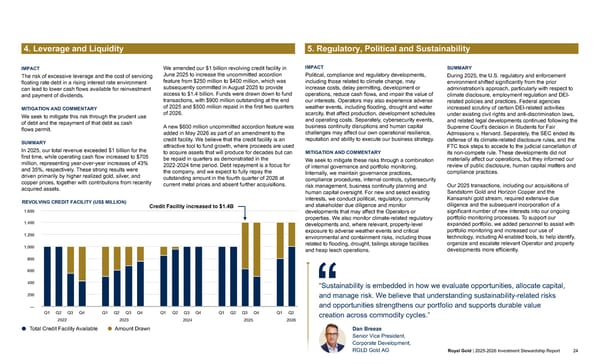
4. Leverage and Liquidity IMPACT The risk of excessive leverage and the cost of servicing floating rate debt in a rising interest rate environment can lead to lower cash flows available for reinvestment and payment of dividends. MITIGATION AND COMMENTARY We seek to mitigate this risk through the prudent use of debt and the repayment of that debt as cash flows permit. SUMMARY In 2025, our total revenue exceeded $1 billion for the first time, while operating cash flow increased to $705 million, representing year-over-year increases of 43% and 35%, respectively. These strong results were driven primarily by higher realized gold, silver, and copper prices, together with contributions from recently acquired assets. We amended our $1 billion revolving credit facility in June 2025 to increase the uncommitted accordion feature from $250 million to $400 million, which was subsequently committed in August 2025 to provide access to $1.4 billion. Funds were drawn down to fund transactions, with $900 million outstanding at the end of 2025 and $500 million repaid in the first two quarters of 2026. A new $600 million uncommitted accordion feature was added in May 2026 as part of an amendment to the credit facility. We believe that the credit facility is an attractive tool to fund growth, where proceeds are used to acquire assets that will produce for decades but can be repaid in quarters as demonstrated in the 2022-2024 time period. Debt repayment is a focus for the company, and we expect to fully repay the outstanding amount in the fourth quarter of 2026 at current metal prices and absent further acquisitions. Q1 Q2 Q3 Q4 Q1 Q2 Q3 Q4 Q1 Q2 Q3 Q4 Q1 Q2 Q3 Q4 Q1 Q2 — 200 400 600 800 1,000 1,200 1,400 1,600 🟇 Total Credit Facility Available 🟇 Amount Drawn REVOLVING CREDIT FACILITY (US$ MILLION) 2022 2023 2024 2025 2026 Credit Facility increased to $1.4B IMPACT 5. Regulatory, Political and Sustainability IMPACT Political, compliance and regulatory developments, including those related to climate change, may increase costs, delay permitting, development or operations, reduce cash flows, and impair the value of our interests. Operators may also experience adverse weather events, including flooding, drought and water scarcity, that affect production, development schedules and operating costs. Separately, cybersecurity events, business continuity disruptions and human capital challenges may affect our own operational resilience, reputation and ability to execute our business strategy. MITIGATION AND COMMENTARY We seek to mitigate these risks through a combination of internal governance and portfolio monitoring. Internally, we maintain governance practices, compliance procedures, internal controls, cybersecurity risk management, business continuity planning and human capital oversight. For new and select existing interests, we conduct political, regulatory, community and stakeholder due diligence and monitor developments that may affect the Operators or properties. We also monitor climate-related regulatory developments and, where relevant, property-level exposure to adverse weather events and critical environmental and containment risks, including those related to flooding, drought, tailings storage facilities and heap leach operations. SUMMARY During 2025, the U.S. regulatory and enforcement environment shifted significantly from the prior administration’s approach, particularly with respect to climate disclosure, employment regulation and DEI- related policies and practices. Federal agencies increased scrutiny of certain DEI-related activities under existing civil rights and anti-discrimination laws, and related legal developments continued following the Supreme Court’s decision in Students for Fair Admissions v. Harvard. Separately, the SEC ended its defense of its climate-related disclosure rules, and the FTC took steps to accede to the judicial cancellation of its non-compete rule. These developments did not materially affect our operations, but they informed our review of public disclosure, human capital matters and compliance practices. Our 2025 transactions, including our acquisitions of Sandstorm Gold and Horizon Copper and the Kansanshi gold stream, required extensive due diligence and the subsequent incorporation of a significant number of new interests into our ongoing portfolio monitoring processes. To support our expanded portfolio, we added personnel to assist with portfolio monitoring and increased our use of technology, including AI-enabled tools, to help identify, organize and escalate relevant Operator and property developments more efficiently. INTRODUCTION ABOUT ROYAL GOLD GOVERNANCE OUR PEOPLE OPERATORS AND COMMUNITIES INVESTMENT STEWARDSHIP APPENDICES Royal Gold | 2025-2026 Investment Stewardship Report 24 “Sustainability is embedded in how we evaluate opportunities, allocate capital, and manage risk. We believe that understanding sustainability-related risks and opportunities strengthens our portfolio and supports durable value creation across commodity cycles.” Dan Breeze Senior Vice President, Corporate Development, RGLD Gold AG
 2025–2026 Investment Stewardship Report Page 23 Page 25