
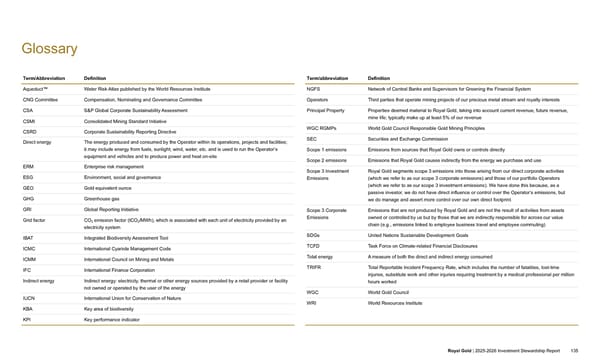
Glossary Term/Abbreviation Definition Aqueduct™ Water Risk Atlas published by the World Resources Institute CNG Committee Compensation, Nominating and Governance Committee CSA S&P Global Corporate Sustainability Assessment CSMI Consolidated Mining Standard Initiative CSRD Corporate Sustainability Reporting Directive Direct energy The energy produced and consumed by the Operator within its operations, projects and facilities; it may include energy from fuels, sunlight, wind, water, etc. and is used to run the Operator’s equipment and vehicles and to produce power and heat on-site ERM Enterprise risk management ESG Environment, social and governance GEO Gold equivalent ounce GHG Greenhouse gas GRI Global Reporting Initiative Grid factor CO 2 emission factor (tCO 2 /MWh), which is associated with each unit of electricity provided by an electricity system IBAT Integrated Biodiversity Assessment Tool ICMC International Cyanide Management Code ICMM International Council on Mining and Metals IFC International Finance Corporation Indirect energy Indirect energy: electricity, thermal or other energy sources provided by a retail provider or facility not owned or operated by the user of the energy IUCN International Union for Conservation of Nature KBA Key area of biodiversity KPI Key performance indicator Term/abbreviation Definition NGFS Network of Central Banks and Supervisors for Greening the Financial System Operators Third parties that operate mining projects of our precious metal stream and royalty interests Principal Property Properties deemed material to Royal Gold, taking into account current revenue, future revenue, mine life; typically make up at least 5% of our revenue WGC RGMPs World Gold Council Responsible Gold Mining Principles SEC Securities and Exchange Commission Scope 1 emissions Emissions from sources that Royal Gold owns or controls directly Scope 2 emissions Emissions that Royal Gold causes indirectly from the energy we purchase and use Scope 3 Investment Emissions Royal Gold segments scope 3 emissions into those arising from our direct corporate activities (which we refer to as our scope 3 corporate emissions) and those of our portfolio Operators (which we refer to as our scope 3 investment emissions). We have done this because, as a passive investor, we do not have direct influence or control over the Operator’s emissions, but we do manage and assert more control over our own direct footprint. Scope 3 Corporate Emissions Emissions that are not produced by Royal Gold and are not the result of activities from assets owned or controlled by us but by those that we are indirectly responsible for across our value chain (e.g., emissions linked to employee business travel and employee commuting) SDGs United Nations Sustainable Development Goals TCFD Task Force on Climate-related Financial Disclosures Total energy A measure of both the direct and indirect energy consumed TRIFR Total Reportable Incident Frequency Rate, which includes the number of fatalities, lost-time injuries, substitute work and other injuries requiring treatment by a medical professional per million hours worked WGC World Gold Council WRI World Resources Institute INTRODUCTION ABOUT ROYAL GOLD GOVERNANCE OUR PEOPLE OPERATORS AND COMMUNITIES INVESTMENT STEWARDSHIP APPENDICES Royal Gold | 2025-2026 Investment Stewardship Report 135
 2025–2026 Investment Stewardship Report Page 134 Page 136