
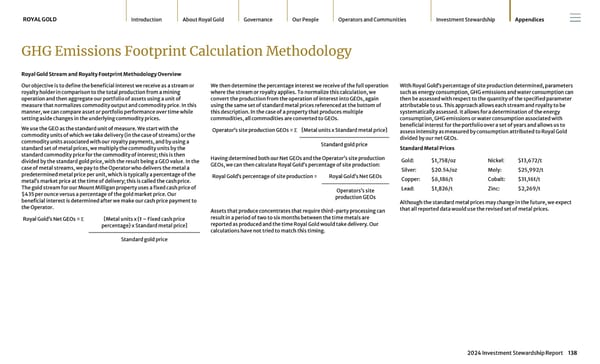
GHG Emissions Footprint Calculation Methodology Royal Gold Stream and Royalty Footprint Methodology Overview Our objective is to define the beneficial interest we receive as a stream or royalty holder in comparison to the total production from a mining operation and then aggregate our portfolio of assets using a unit of measure that normalizes commodity output and commodity price. In this manner, we can compare asset or portfolio performance over time while setting aside changes in the underlying commodity prices. We use the GEO as the standard unit of measure. We start with the commodity units of which we take delivery (in the case of streams) or the commodity units associated with our royalty payments, and by using a standard set of metal prices, we multiply the commodity units by the standard commodity price for the commodity of interest; this is then divided by the standard gold price, with the result being a GEO value. In the case of metal streams, we pay to the Operator who delivers the metal a predetermined metal price per unit, which is typically a percentage of the metal’s market price at the time of delivery; this is called the cash price. The gold stream for our Mount Milligan property uses a fixed cash price of $435 per ounce versus a percentage of the gold market price. Our beneficial interest is determined after we make our cash price payment to the Operator. Royal Gold’s Net GEOs = Ʃ [Metal units x (1 – Fixed cash price percentage) x Standard metal price] Standard gold price We then determine the percentage interest we receive of the full operation where the stream or royalty applies. To normalize this calculation, we convert the production from the operation of interest into GEOs, again using the same set of standard metal prices referenced at the bottom of this description. In the case of a property that produces multiple commodities, all commodities are converted to GEOs. Operator’s site production GEOs = Ʃ [Metal units x Standard metal price] Standard gold price Having determined both our Net GEOs and the Operator’s site production GEOs, we can then calculate Royal Gold’s percentage of site production: Royal Gold’s percentage of site production = Royal Gold’s Net GEOs Operators’s site production GEOs Assets that produce concentrates that require third-party processing can result in a period of two to six months between the time metals are reported as produced and the time Royal Gold would take delivery. Our calculations have not tried to match this timing. With Royal Gold’s percentage of site production determined, parameters such as energy consumption, GHG emissions and water consumption can then be assessed with respect to the quantity of the specified parameter attributable to us. This approach allows each stream and royalty to be systematically assessed. It allows for a determination of the energy consumption, GHG emissions or water consumption associated with beneficial interest for the portfolio over a set of years and allows us to assess intensity as measured by consumption attributed to Royal Gold divided by our net GEOs. Standard Metal Prices Gold: $1,758/oz Silver: $20.54/oz Copper: $6,186/t Lead: $1,826/t Nickel: $13,672/t Moly: $25,992/t Cobalt: $31,161/t Zinc: $2,269/t Although the standard metal prices may change in the future, we expect that all reported data would use the revised set of metal prices. ROYAL GOLD Introduction About Royal Gold Governance Our People Operators and Communities Investment Stewardship Appendices 138 2024 Investment Stewardship Report
 2024 Investment Stewardship Report Page 137 Page 139