
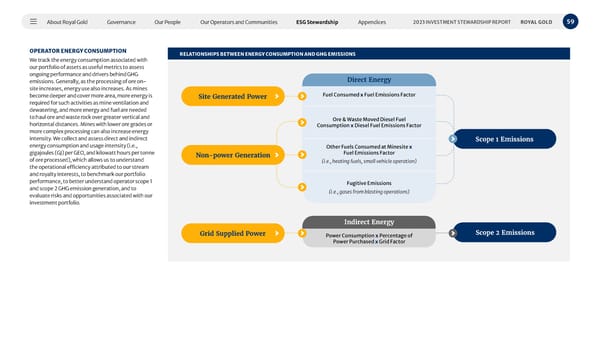
About Royal Gold Governance Our People Our Operators and Communities ESG Stewardship Appendices 59 2023 INVESTMENT STEWARDSHIP REPORT ROYAL GOLD OPERATOR ENERGY CONSUMPTION We track the energy consumption associated with our portfolio of assets as useful metrics to assess ongoing performance and drivers behind GHG emissions. Generally, as the processing of ore on- site increases, energy use also increases. As mines become deeper and cover more area, more energy is required for such activities as mine ventilation and dewatering, and more energy and fuel are needed to haul ore and waste rock over greater vertical and horizontal distances. Mines with lower ore grades or more complex processing can also increase energy intensity. We collect and assess direct and indirect energy consumption and usage intensity (i.e., gigajoules (GJ) per GEO, and kilowatt hours per tonne of ore processed), which allows us to understand the operational efficiency attributed to our stream and royalty interests, to benchmark our portfolio performance, to better understand operator scope 1 and scope 2 GHG emission generation, and to evaluate risks and opportunities associated with our investment portfolio. RELATIONSHIPS BETWEEN ENERGY CONSUMPTION AND GHG EMISSIONS Scope 1 Emissions Scope 2 Emissions Fuel Consumed x Fuel Emissions Factor Ore & Waste Moved Diesel Fuel Consumption x Diesel Fuel Emissions Factor Other Fuels Consumed at Minesite x Fuel Emissions Factor (i.e., heating fuels, small vehicle operation) Fugitive Emissions (i.e., gases from blasting operations) Direct Energy Indirect Energy Power Consumption x Percentage of Power Purchased x Grid Factor Non-power Generation Site Generated Power Grid Supplied Power
 2023 Investment Stewardship Report Page 58 Page 60