
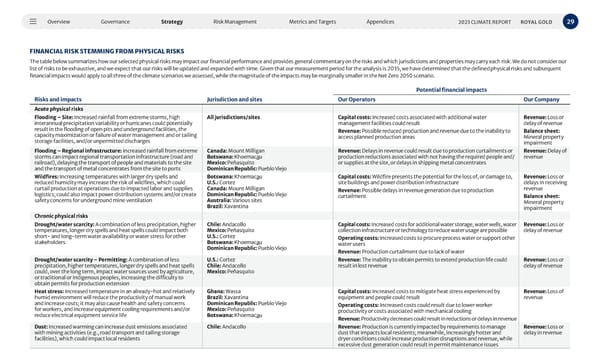
Overview Governance Strategy Risk Management Metrics and Targets Appendices 29 2023 CLIMATE REPORT ROYAL GOLD FINANCIAL RISK STEMMING FROM PHYSICAL RISKS The table below summarizes how our selected physical risks may impact our financial performance and provides general commentary on the risks and which jurisdictions and properties may carry each risk. We do not consider our list of risks to be exhaustive, and we expect that our risks will be updated and expanded with time. Given that our measurement period for the analysis is 2035, we have determined that the defined physical risks and subsequent financial impacts would apply to all three of the climate scenarios we assessed, while the magnitude of the impacts may be marginally smaller in the Net Zero 2050 scenario. Potential financial impacts Risks and impacts Jurisdiction and sites Our Operators Our Company Acute physical risks Flooding – Site: Increased rainfall from extreme storms, high interannual precipitation variability or hurricanes could potentially result in the flooding of open pits and underground facilities, the capacity maximization or failure of water management and or tailing storage facilities, and/or unpermitted discharges All jurisdictions/sites Capital costs: Increased costs associated with additional water management facilities could result Revenue: Possible reduced production and revenue due to the inability to access planned production areas Revenue: Loss or delay of revenue Balance sheet: Mineral property impairment Flooding – Regional infrastructure: Increased rainfall from extreme storms can impact regional transportation infrastructure (road and railroad), delaying the transport of people and materials to the site and the transport of metal concentrates from the site to ports Canada: Mount Milligan Botswana: Khoemac a u Mexico: Peñasquito Dominican Republic: Pueblo Viejo Revenue: Delays in revenue could result due to production curtailments or production reductions associated with not having the required people and/ or supplies at the site, or delays in shipping metal concentrates Revenue: Delay of revenue Wildfires: Increasing temperatures with larger dry spells and reduced humidity may increase the risk of wildfires, which could curtail production at operations due to impacted labor and supplies logistics; could also impact power distribution systems and/or create safety concerns for underground mine ventilation Botswana: Khoemac a u U.S.: Cortez Canada: Mount Milligan Dominican Republic: Pueblo Viejo Australia: Various sites Brazil: Xavantina Capital costs: Wildfire presents the potential for the loss of, or damage to, site buildings and power distribution infrastructure Revenue: Possible delays in revenue generation due to production curtailment Revenue: Loss or delays in receiving revenue Balance sheet: Mineral property impairment Chronic physical risks Drought/water scarcity: A combination of less precipitation, higher temperatures, longer dry spells and heat spells could impact both short- and long-term water availability or water stress for other stakeholders Chile: Andacollo Mexico: Peñasquito U.S.: Cortez Botswana: Khoemac a u Dominican Republic: Pueblo Viejo Capital costs: Increased costs for additional water storage, water wells, water collection infrastructure or technology to reduce water usage are possible Operating costs: Increased costs to procure process water or support other water users Revenue: Production curtailment due to lack of water Revenue: Loss or delay of revenue Drought/water scarcity – Permitting: A combination of less precipitation, higher temperatures, longer dry spells and heat spells could, over the long term, impact water sources used by agriculture, or traditional or Indigenous peoples, increasing the difficulty to obtain permits for production extension U.S.: Cortez Chile: Andacollo Mexico: Peñasquito Revenue: The inability to obtain permits to extend production life could result in lost revenue Revenue: Loss or delay of revenue Heat stress: Increased temperature in an already-hot and relatively humid environment will reduce the productivity of manual work and increase costs; it may also cause health and safety concerns for workers, and increase equipment cooling requirements and/or reduce electrical equipment service life Ghana: Wassa Brazil: Xavantina Dominican Republic: Pueblo Viejo Mexico: Peñasquito Botswana: Khoemac a u Capital costs: Increased costs to mitigate heat stress experienced by equipment and people could result Operating costs: Increased costs could result due to lower worker productivity or costs associated with mechanical cooling Revenue: Productivity decreases could result in reductions or delays in revenue Revenue: Loss of revenue Dust: Increased warming can increase dust emissions associated with mining activities (e.g., road transport and tailing storage facilities), which could impact local residents Chile: Andacollo Revenue: Production is currently impacted by requirements to manage dust that impacts local residents; meanwhile, increasingly hotter and dryer conditions could increase production disruptions and revenue, while excessive dust generation could result in permit maintenance issues Revenue: Loss or delay in revenue
 2023 Climate Report Page 28 Page 30