
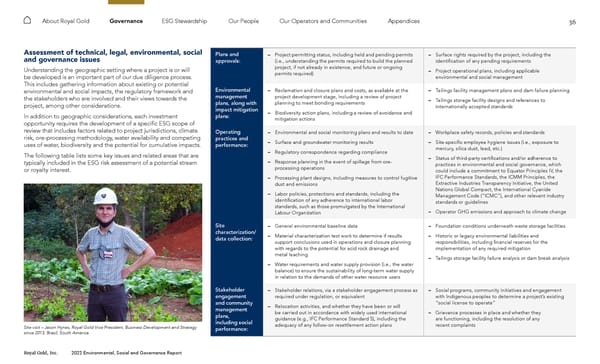
36 Royal Gold, Inc. 2022 Environmental, Social and Governance Report About Royal Gold Governance ESG Stewardship Our People Our Operators and Communities Appendices Assessment of technical, legal, environmental, social and governance issues Understanding the geographic setting where a project is or will be developed is an important part of our due diligence process. This includes gathering information about existing or potential environmental and social impacts, the regulatory framework and the stakeholders who are involved and their views towards the project, among other considerations. In addition to geographic considerations, each investment opportunity requires the development of a specific ESG scope of review that includes factors related to project jurisdictions, climate risk, ore-processing methodology, water availability and competing uses of water, biodiversity and the potential for cumulative impacts. The following table lists some key issues and related areas that are typically included in the ESG risk assessment of a potential stream or royalty interest. Plans and approvals: – Project permitting status, including held and pending permits (i.e., understanding the permits required to build the planned project, if not already in existence, and future or ongoing permits required) – Surface rights required by the project, including the identification of any pending requirements – Project operational plans, including applicable environmental and social management Environmental management plans, along with impact mitigation plans: – Reclamation and closure plans and costs, as available at the project development stage, including a review of project planning to meet bonding requirements – Biodiversity action plans, including a review of avoidance and mitigation actions – Tailings facility management plans and dam failure planning – Tailings storage facility designs and references to internationally accepted standards Operating practices and performance: – Environmental and social monitoring plans and results to date – Surface and groundwater monitoring results – Regulatory correspondence regarding compliance – Response planning in the event of spillage from ore- processing operations – Processing plant designs, including measures to control fugitive dust and emissions – Labor policies, protections and standards, including the identification of any adherence to international labor standards, such as those promulgated by the International Labour Organization – Workplace safety records, policies and standards – Site-specific employee hygiene issues (i.e., exposure to mercury, silica dust, lead, etc.) – Status of third-party certifications and/or adherence to practices in environmental and social governance, which could include a commitment to Equator Principles IV, the IFC Performance Standards, the ICMM Principles, the Extractive Industries Transparency Initiative, the United Nations Global Compact, the International Cyanide Management Code (“ICMC”), and other relevant industry standards or guidelines – Operator GHG emissions and approach to climate change Site characterization/ data collection: – General environmental baseline data – Material characterization test work to determine if results support conclusions used in operations and closure planning with regards to the potential for acid rock drainage and metal leaching – Water requirements and water supply provision (i.e., the water balance) to ensure the sustainability of long-term water supply in relation to the demands of other water resource users – Foundation conditions underneath waste storage facilities – Historic or legacy environmental liabilities and responsibilities, including financial reserves for the implementation of any required mitigation – Tailings storage facility failure analysis or dam break analysis Stakeholder engagement and community management plans, including social performance: – Stakeholder relations, via a stakeholder engagement process as required under regulation, or equivalent – Relocation activities, and whether they have been or will be carried out in accordance with widely used international guidance (e.g., IFC Performance Standard 5), including the adequacy of any follow-on resettlement action plans – Social programs, community initiatives and engagement with Indigenous peoples to determine a project’s existing “social license to operate” – Grievance processes in place and whether they are functioning, including the resolution of any recent complaints Site visit – Jason Hynes, Royal Gold Vice President, Business Development and Strategy since 2013, Brazil, South America
 2022 ESG Report Page 35 Page 37